Monday, January 17, 2011

6-Year Old Receives Life-Saving Heart Surgery


In partnership with Boston Children’s Hospital in Ghana, GHEI has facilitated a successful heart surgery for another patient in the BAB District. Six-year-old Portia Adjei Nipa (pictured left) was diagnosed with heart disease as an infant at the Ghana Bauxite Company hospital, a private hospital in Ghana’s Western Region. For years she suffered bouts of lethargy and difficulty breathing before she was hospitalized in 2008 at Korle-Bu Hospital in Ghana’s capital, Accra, where she received an initial cardiac surgery. She needed a follow-up operation, which was scheduled for April 2010 and would cost a prohibitive 6,000 euros. Her father (pictured right with Portia) tried in vain to fund-raise this money while Portia’s health rapidly declined: she was too weak to walk, talk, or attend school.

Thanks to the assessment and referral of UCLA Pediatric residents working with GHEI, Portia received her second surgery in October 2010. A team of pediatric cardiac surgeons from Boston Children’s Hospital supervised the surgery at Komfo Anokye Teaching Hospital (KATH) as part of a medical mission to develop a self-sustaining pediatric cardiac center in Ghana. In 2008, GHEI began working with the Boston Children’s Hospital in Ghana team to identify rurally-based children with congenital heart disease and refer them for free surgery. Since her surgery in October, Portia has shown marked improvement: she walks and talks freely and her recovery looks promising. To date, 6 children have been treated for congenital heart disease and 4 have received life-saving heart surgeries thanks to GHEI’s advocacy efforts.


Read more about GHEI’s support of local health services on our website: http://ghei.org/health/support_of_local_healthcare_services.html

For more information on Boston Children’s Hospital in Ghana, visit their website: http://childrensinghana.typepad.com/childrens_hospital_boston/childrens-in-ghana.htm


--Natalie Rich, GHEI Communications Director


Share |

Friday, January 7, 2011

GHEI Community Health Worker Wins District Assembly Election


“I am proud to be the youngest District Assemblyperson in this district” beamed 24-year-old Dickson Ackah Mensah, the newly elected local representative and GHEI Community Health Worker. On the last day of 2010, constituents of the Bibiani-Anhwiaso-Bekwai (BAB) District of Ghana’s Western Region cast their ballots in the local elections. According to their website (http://bab.ghanadistricts.gov.gh/):

The Bibiani-Anhwiaso-Bekwai District Assembly (BABDA) was set up in 1988. Like all other districts/municipal/metropolitan Assemblies, it was set up to decentralize national administration and development and to afford opportunities to all localities to identify and resolve their social and development problems. BABDA ‘s jurisdiction covers 30 Assembly Electoral Areas made up of 9 Area Councils and 110 Unit Committees. The functions of the Assembly fall in three main areas. These are:

  • Legislative which involves the formulation of bye-laws within the district;
  • Deliberative which involves the various discussions and deliberations made on the development of the district; and
  • Executive Functions which involves the execution of policies and projects within the district.

After securing 65% of the vote, Dickson Ackah Mensah won a seat in the District Assembly representing the Ampenkro electoral area. Assembly representatives serve a 4-year term, without term limits, and do not get paid for their service. Here, Dickson discusses his decision to run for District Assembly and goals for his upcoming term:

GHEI: Tell me about your background.

DICKSON: Both of my parents died when I was young so my uncle, who is a primary school teacher, took responsibility for me and funding my education. I completed primary and junior high school here in Ampenkrom, my home village, before attending Bekwai Senior High School, where I studied Business. I graduated senior high in 2007.

GHEI: How did you become involved with GHEI?

DICKSON: In August 2008, I was selected to be trained as a Peer Educator in GHEI’s Multi-Sectoral HIV and AIDS Program [HIV education program that GHEI implemented 2007-2010 in partnership with the Ghana AIDS Commission]. As a Peer Educator, I conducted outreaches in and around Ampenkrom, educating young people about HIV/AIDS prevention, and I helped plan GHEI’s World AIDS Day Event in 2008, hosted by Ampenkrom. In 2010, I became a GHEI Community Health Worker and coordinated the summer de-worming program in Ampenkrom with a group of US volunteers.

GHEI: Why did you choose to run for District Assembly?

DICKSON: I have seen so many problems in this community, and I felt that local elected officials were not doing enough to help. I wanted to address some of these problems, like the lack of proper school infrastructure and education supplies, so that I can help the people in my community.

GHEI: What area do you represent as District Assemblyman?

DICKSON: I represent Ampenkrom, which is around 2000 people, and Gyponkrom, which is only about 60 people.

GHEI: Can you tell me more about your duties as Assemblyman?

DICKSON: The first thing I will do, after being sworn in later this month, is meet with the newly elected Unit Committee to draft our strategic plan for the year which we will then submit for district approval. The District Assembly formally meets 4 times per year in Bibiani [district capital] to review progress on our strategic plans. As Assemblyman, I will meet with the Unit Committee [5-member elected administrative body] every 2 weeks to address our goals in the strategic plan.

GHEI: What do you hope to accomplish as District Assemblyman?

DICKSON: First, I want to focus on education. We have 1 primary school here with over 200 students and 1 Junior High with 74 students, but we lack sufficient teachers. Also, many of our classrooms do not have chairs for the students or supplies like books. The primary school building is also in very poor condition. So I hope to appeal to the District Leaders for funding and solutions to these issues. In regards to health, I want to propose building a community-based clinic for this area, because the nearest clinic is more than 6 kilometers from here and many people have no choice but to walk. We really need a clinic here.

For more information on the district in which GHEI operates, the Bibiani-Anhwiaso-Bekwai District, visit their website http://bab.ghanadistricts.gov.gh/. For further information on district and regional government in Ghana, go to http://www.ghanadistricts.com/home/


--Natalie Rich, GHEI Communications Director

Wednesday, December 15, 2010

Follow GHEI on Twitter!

GHEI is now on Twitter! Follow us today and tell us what you want to hear about! Follow GHEIHumjibre on Twitter

Monday, December 13, 2010

Humjibre Schools Compete in District Football Tournament


If Ghana had a national past-time, it would undoubtedly be soccer, known internationally as ‘football.’ Schools throughout the Bibiani-Anwhiaso-Bekwai (BAB) District, public and private, suspended classes the last week of November, so that students could compete in the annual Athletics Gala, a weeklong sports contest featuring track events and a football tournament. Humjibre’s primary and junior high schools kicked off the week with track races from the 100 meter dash up to 5K run.

But the crowning event came on Thursday with the junior high football game that would decide which school advances to the District semifinals in Bekwai. Historically, Humjibre’s Anglican Junior High has dominated this event over the smaller Deeper Life and Muoho Junior High schools, with the Anglican boys’ team advancing all the way to the finals in Bibiani in 2005. GHEI staff joined the community at the Humjibre football field, a dusty expanse lacking the turf or markings of a proper field, to cheer on their favoured teams. With a first quarter goal, the Anglican boys’ team defeated Muoho 1-0, securing them a spot in the semis at Bekwai. Penalty shoot-outs decided the girls’ matches with Deeper Life defeating Muoho 4-3, after Muoho defeated Anglican 4-3.

Humjibre and the surrounding communities look forward to cheering these teams to victory at Bekwai later this month.


--Natalie Rich, GHEI Communications Director


Share |

Friday, December 3, 2010

GHEI Celebrates World AIDS Day

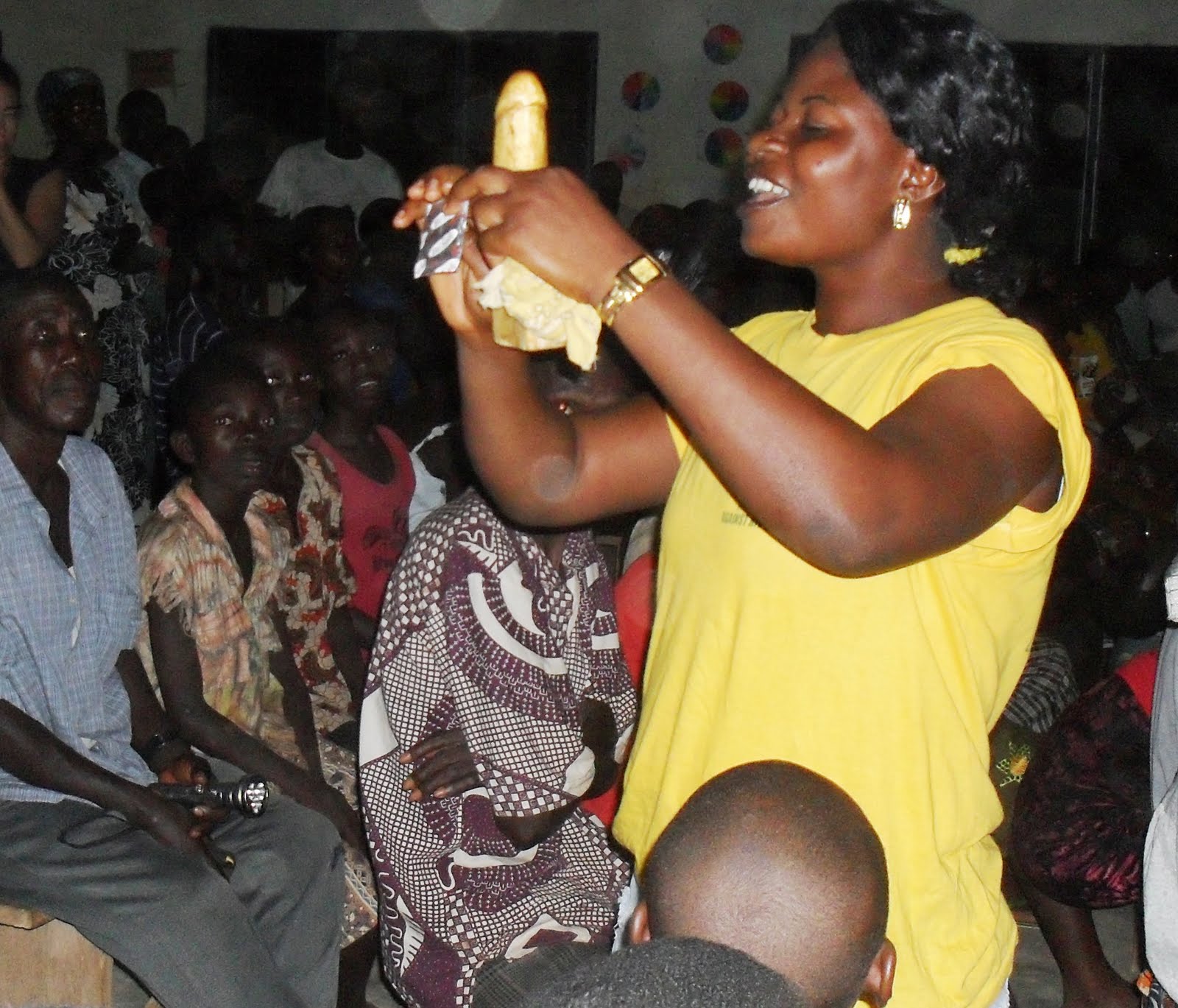
GHEI Community Health Worker (CHW), Lydia Ampomaning, demonstrates how to use a condom to a group of giggling adolescents at GHEI’s World AIDS Day celebration. Over 200 people, including Humjibre’s Chief and Elders, gathered at Humjibre Community Centre for this year’s festivities, where a DJ kicked off the event at 6:30pm. By 7:30, the hall was packed. GHEI Program Manager Clement Donkor opened by explaining that stigmas and misconceptions still run rampant in Humjibre and around the world. He urged community members to avoid spreading the disease by using condoms and to fight the stigma which prevents so many from seeking testing and treatment. Following his comments, a series of short films were shown, ranging from a cartoon illustration of the AIDS virus attacking the body and a re-enactment showing a person getting tested for HIV.

Humjibre CHWs moved through the crowd demonstrating proper condom use in small groups and addressing audience questions. One high school student, Stephen, commented that the videos answered some of the questions he had about HIV/AIDS and how it is spread. Like many of the young people who attended, Stephen chose to remain on the outskirts of the crowd, but gradually migrated to the front when the CHWs began the condom demonstrations.
Select staff and CHWs managed two confidential condom distribution stations outside the event, allowing men and women to receive condoms in separate discreet locations. Over 800 condoms were distributed during the celebration, and all GHEI CHWs and Peer Educators received 26 condoms to distribute among people in the surrounding communities.

Humjibre’s Chief, Nana Kwadwo Twum II, closed the celebration by reminding people that HIV/AIDS remains both a global and a local problem. He urged people to protect themselves through abstinence and condom use. Thanking GHEI for its efforts to educate people and to promote HIV/AIDS awareness, he explained the importance of fighting diseases like HIV/AIDS in communities like Humjibre: “Reducing HIV leads to a healthier community, and a healthy community surely paves the way towards development.” Read more about how GHEI promotes HIV/AIDS prevention and sexual health in the Reproductive Health section of GHEI Programs page.


--Natalie Rich, GHEI Communications Director


Friday, November 26, 2010

GHEI Welcomes New Health Program Coordinator

Amid candle light and a traditional Ghanaian meal of fried chicken and jollof rice, GHEI staff gathered to bid farewell to Christina Briglieb, GHEI’s outgoing Health Program Coordinator. The evening proved bittersweet as the Health Team and Humjibre Community Health Workers (CHWs) paid tribute to Christina and her service to GHEI. With a Master’s Degree in Public Health and more than 2 years of international experience, Christina arrived with a wealth of research skills and cross-cultural awareness. She collaborated closely with GHEI’s Malaria Program Manager, Mensah Gyapong, Humjibre’s CHW Manager, Agnes Obeng, and both the Humjibre and Surano CHWs on a myriad of projects including: planning and facilitating a household malaria education program in which 2000 bednets were hung in 400 households; organizing a system for monitoring and evaluating the malaria program; expanding upon GHEI’s school Hand-Washing Program; and forging partnerships with the Bibiani District Health Service. Her numerous contributions have benefited staff and community members alike.


Though Christina will surely be missed, GHEI eagerly welcomes Carly Edwards to the Health Team as the new Health Program Coordinator. A former Peace Corps volunteer in Morocco, Carly received her Master’s Degree in International Development and Social Change at Clark University and brings more than 3 years of development project experience from Morocco, Ghana, and South Africa. For the past month, Carly worked alongside Christina to develop a framework for her 13-month term, which will involve expanding GHEI’s malaria program to the neighboring village of Kojina, building on GHEI’s reproductive health program, and facilitating training for GHEI’s Health Team.


This week, Carly launched into her new position with a staff training on GPS Data Collection and GIS Mapping. Local staff will utilize these skills to map Kojina, a GHEI satellite community and the next target village for GHEI’s malaria education and bednet distribution program. Carly’s skills and experience will build on Christina’s accomplishments and ensure future success for GHEI’s Health Programs.


--Natalie Rich, GHEI Communications Director

Wednesday, October 20, 2010

GHEI holds community meeting to discuss research results

GHEI held a community meeting in the community center in early September. More than 110 people attended including the village chief, queen mother and elders.

The goal of the meeting was to relay why GHEI does research, the results of recent research and to allow the community and chief an opportunity to discuss the findings. Planning for the event included a series of meetings with the village chief to discuss research in general, recent research results and the strategy for the community meeting.

Diana Rickard, MD, GHEI’s Executive Director, informed the audience that GHEI performs research for two reasons: to gain information that helps the organization plan programs to improve the health and education of the community’s children or to improve current programs.

She then discussed results from the general survey performed in 2009.  Highlights included that half of the population is under age 18, half of households rely on unimproved water sources, half have electricity and half have latrines.  The chief implored the audience to improve household conditions by removing trash and installing household latrines.

The audience then learned that occupations are highly stratified by gender, one third of adults have had no formal education, 90% of adults have no education beyond middle school level and that males receive far more education than females.  The chief added that all children deserve the investment of education and females must be educated.  He also reinforced GHEI’s health programming in handwashing and malaria prevention after a discussion of the need for improved bednet usage and high rates of diarrhea.

Clement Donkor, GHEI’s Program Director, continued the presentation with a discussion of community priorities for children communicated during a 2010 qualitative study.  Of all age groups under age 18, the community prioritized children under age 5 years the most.  Education, opportunities, illness and health care topped the list of priorities.  The results of this work will help inform GHEI’s programming in the coming five years.

Jen Artibello, GHEI’s Education Program Coordinator, then showed the results of the national exam pass rates after Junior High School for all students and for girls and boys separately.  The pass rate for girls increased from 4% in 2001 to 98% in 2009.  The audience was amazed and excited to learn how far Humjibre’s youth had come in just a few years.

A local radio station covered the event and conducted a live interview with Clement Donkor.


Thursday, October 7, 2010

GHEI's Annual Leadership Retreat

GHEI held its annual retreat in Winneba this year with thirteen people in attendance. The first three days of the five-day retreat focused on discussion to develop GHEI’s five-year strategic plan. These discussions included refining our vision, reviewing GHEI’s history to launch a discussion of values, discussing baseline quantitative and qualitative research, establishing priority areas and approaches and drafting five-year plans by sector.

We also created a plan to improve our capacity building approach that will start with a comprehensive assessment by Jen Artibello, our Education Program Coordinator and Clement Donkor, GHEI’s Program Director. One component of in-service training will be on planning and monitoring programs and will be led by Jen Artibello through weekly sessions in January-March 2011.

In an effort to improve our focus on girls, we created a plan to increase the percentage of girls to 60% in our early childhood education, youth education and scholarship programs. We will also begin an annual award for the top female student in Senior High School. A new quarterly staff evaluation process was approved at retreat as well.


The completion of retreat was marked by an award ceremony for staff.

Thursday, September 23, 2010

Training for health care providers at Bibiani District Hospital

GHEI hosted an American emergency medicine physician, Dr. Daniel Patenaude, for a training assessment visit in September. His goals were to better understand the health system and health care delivery in Bibiani District, GHEI’s role within the health system and its priorities. He also hoped to forge relationships with the district health leaders and to conduct training on topics related to emergency medicine. On all accounts, his visit was successful. It culminated in a half-day training on the initial evaluation of a trauma patient and on treating shoulder and hip dislocations.

Sunday, July 25, 2010

A Note From Katrina

During Winter quarter of my junior year of college, I got the incredible opportunity to work with GHEI on the Sorano Malaria project. For twelve weeks the Sorano community health care workers and I conducted WHO surveys that evaluated the effectiveness of a bed net intervention one year later. Every day was a learning experience as I developed insights into Ghanaian culture and learned how this influences behaviors that affect health. A year and a half later, my friends still joke that any experience I have I can relate back to “this one time in Ghana...” After working on a project where I felt my time and efforts directly correlated with change, it was difficult returning to a classroom to simply learn about global problems rather build a tool set to help address these. To fuel my desire to make concrete changes I gave up the 20+ hours a week I was devoting to varsity swimming, took an internship at Dartmouth’s Dickey Center for International Understanding, and became the Community Development Officer for a two week winter break trip to Nicaragua.

From my experiences working with the CHWs in Sorano and from exposure to Rotary International’s passing Polio eradication campaign, I became intrigued by monitoring and evaluation of global health initiatives. After experiencing the cultural biases and miscommunication that can occur when conducting “Western” surveys in a “non-Western” culture, I was curious how these miscommunications could be prevented and also curious how large scale initiatives could gain the trust of participants living in rural communities. Next year I will be doing a post-bachelor fellowship with the Institute of Health Metrics and Evaluation where I will have the opportunity to work alongside some of the top researchers in the field of global health, build skills in quantitative and qualitative analysis, and jointly pursue a MPH from the University of Washington. My experiences in Sorano cemented my interest in global health and have since opened up numerous opportunities that have enabled me to pursue these interests. I want to thank everyone at GHEI for taking them time to share their lives and culture with me. My relationships with all of you are what have fueled my passion to pursue this line of work; I think of you all often!

--Katrina