Tuesday, July 17, 2012

Kick Off

Share |


The game that Americans and Canadians know as soccer is the much-loved game of football to Ghanaians.  At the 2010 FIFA World Cup in South Africa, Ghana's national football team, the Black Stars, became the third African team in history to reach the World Cup quarter-finals.

Kickin' it volunteers Dawn, Kyle and Akshat
With football so hugely popular in Ghana, GHEI is thrilled to welcome our third group of Summer Serve and Learn volunteers for their session, “Kickin’ it in Ghana.” As GHEI’s summer camp for youth, this session focuses on building strong leadership and communication skills through football training.  Our volunteers had to hit the ground running, holding their first planning session the morning after their arrival. 

The camp opened on Saturday, with an exciting array of team-building activities planned for Humjibre’s keen footballers. One exercise had participants blindfolded and racing against each other through a mock "minefield," attempting to avoid obstacles as their team mates shouted helpful directions to them from the start line.  Colliding with obstacles slowed runners down and could cost them the race, so this activity stressed the importance of strong communication between team members.  

Next, participants lined up, holding the shoulders of the teammate in front of them in a game of “caterpillar.”  Team members could move only one step at a time and only after the person in front of them had moved.  Moving systematically and coordinating their individual movements with the whole group proved to be too much for some flustered links in the long chain, and the caterpillar lurched along hilariously, with jam-ups hindering the flow the group was aiming for.
By far the most entertaining activity to watch was the “Dizzy Izzy” race, in which each contestant held a dowel to his head and pinned it to the ground, spinning around ten times and then racing half the length of the soccer pitch.  Some did remarkably well, despite their wobbly footing, but others staggered off in dizzy disarray, veering diagonally across the field until they collapsed in the dirt, much to the amusement of all onlookers.

Kate Belser, a volunteer from last year’s “Kickin’ it” session, has returned this year to serve as volunteer coordinator for this session.  “This was a new session for Summer Serve and Learn last year, and it was hard to see which direction it would head in afterwards," says Kate.  "We got such a terrific response from the community that we knew this should be a regular part of GHEI summer programming.  I saw so much potential in this camp and had so much fun last year, it only made sense to come back to Humjibre and help further develop the program. It really helps to strengthen community relations and builds strong communications skills by tapping into the kids’ interests and their sense of fun.”

Our volunteers are now keeping busy by running nightly training sessions with each of the six different football teams.  Activities include the classic trust-building “trust fall,” potato sack races, and role-playing on the dos and don’ts of proper sportsmanship.  These training sessions are all building up to a two-day football competition this coming weekend, which will see the six teams vying for the championship.  These young footballers take their sport very seriously and are training hard to reach top rank.  May the best team win!

Share |

Thursday, July 5, 2012

To the Victors Go the Spoils

Share |

As a conclusion to GHEI’s month long Read-A-thon, some of Humjibre’s brightest primary and junior high school students faced off in a Quiz competition this past Friday.


The students had been preparing for this big day for the whole month and were filled with anxiety at the prospect of sitting in front of their fellow students and families to be tested on their comprehension of selected texts. The presence of the Chief of Humjibre, Nana Kwadwo Twum II, and other town elders only added to the young pupils apprehensions.


The quiz had the different schools competing against each other in answering a series of questions regarding the content of a storybook.  Participants had to think on their feet, as their response time was limited.  The students’ nervousness was visible and understandable.  Every one of their answers could either cost their school the competition, or lead them to victory, propelling them into the upper echelons of schoolyard adulation.
Their voices trembled as they delivered their responses and the silence as they waited for the Quizmaster’s verdict, correct or incorrect, must have seemed endless to our young contenders.  But as with all competitions one group stood out from the rest, and this was Anglican Primary School.  They proved to have studied the hardest and to have worked closely with their teachers to know the material inside and out.

Speaking with the Chief after the ceremony he made it clear that he was very pleased with the competition:  “This is the first Quiz Competition we’ve held in Humjibre, and it went very well.  I’m happy with the students, and now they will know how hard they will have to study to win next year.”

As if this was not enough excitement for the students of Humjibre, the following night GHEI held the highly anticipated Read-A-thon Awards Ceremony.  Our staff had tallied up the participants' reading points and the time had come to award the readers for their dedication.  Students with a moderate score were given colourful storybooks, while high scoring readers had something more in store for them.  Our “Read and Play” volunteers had brought an assortment of soccer jerseys to be awarded to the most studious readers.


As soon as the master of ceremonies revealed the first jersey the room broke out in pandemonium. The children screamed at the top of their lungs in jubilation while jumping up and down, bumping into one another in a mosh pit more befitting of a metal concert. The next several minutes were spent controlling the enraptured crowd and continuing the presentation of the various jerseys.  The crowd shouted with glee at the sight of each jersey, but the best was saved for last.
The overall winner of the Read-A-thon was to be given a particularly special Chelsea jersey.  The jersey was held up for the audience and turned around to reveal the name of every Ghanaian football fan's pride and joy, Michael Essien.  At the sight of this the room once again broke out into a small riot.  The winner was quickly announced, and one very proud Ebenezer Apemchom emerged from the crowd.  With a heartwarming smile and misty eyes he accepted his prize as the crowd let out a roaring applause.


GHEI would like to thank all those who made the Read-A-Thon and Quiz Competition possible, including staff, our international volunteers, and in particular Mr. Francis Gardler, who along with his family and friends donated the soccer gear that became wonderful prizes for our top readers.  And of course, we can’t forget the Read-A-thon participants themselves.  We are proud of their dedicated reading for the past month.  Well done!
 
Share |

Thursday, June 28, 2012

Book Walk

Share |


The volunteers involved in our “Read and Play” session of Summer Serve and Learn have recently arrived in Humjibre and are thrilled to hit the ground running.  “I just want to help out in any way I can.  Even if it’s just one person and it’s something as simple as helping a kid read a book,” said Anna, a volunteer from Pennsylvania.


The “Read and Play” session runs in coordination with the ongoing ReadAthon and has our volunteers running outreach programs to local schools, teaching reading skills as well as how to take good care of books. 

The volunteers have been teaching their young pupils the concept of a “book walk.” 
This starts with an overview of the book itself, examining the cover, its author and the back cover.  With the younger kids they’ll then take a look through the pictures, while with the older students they’ll read through the synopsis, glossary and comprehension questions to guide them in their reading.  The “book walk” serves as a learning tool for these enthusiastic students by improving their comprehension skills, but also gives students the ability to seek out the books they’re actually interested in reading.

 
To help the children retain these instructions, the volunteers have made use of a catchy little song:
Time to take a Book Walk
And see what we can see.
The cover words and pictures
All tell us what might be.
We’ll use our imaginations
Guess what the characters might do
Then we’ll read the book itself
And see if it comes true!

When asked about what they expected from their two-week program it was evident that our volunteers knew that this would be as much of a learning experience for them as it is for their students.  One volunteer, Pearl, from Southern California, had this to say: “I have a feeling I’ll learn a lot about the culture and lifestyle here in Ghana through teaching the children.  I think this will really put things into perspective in terms of what we take for granted back home.”

Another volunteer, John, from Minnesota, remarked: “I expect to meet some great people here in Ghana and really experience their culture.  I’m looking forward to learning more about child literacy so that I’m able to draw comparisons to some of the literacy programs I’ve worked with in Peru as well as the United States.”


Our volunteers are also kept busy creating a series of questions for the participants of the upcoming Quiz Competition, in which primary and junior high school students from around Humjibre will compete in reading comprehension of selected texts, as well as trivia questions about Ghana and Africa.


We at GHEI are delighted to have such a passionate group of volunteers, each making meaningful contributions to our efforts in improving literacy.  Keep up the awesome work!

Read and Play volunteers Anna, Phil, John, Ally, Akshat and Pearl
Share |

Thursday, June 21, 2012

Avid Readers


Share |

It’s just before 2 pm and a crowd of excited school children have gathered around the doors of GHEI’s library.  They chatter and laugh, some kicking around a soccer ball, others playing jacks with pebbles.  All of these children have finished their school day, but are here eagerly awaiting the start of the daily ‘Read-a-thon’.  The Read-a-thon is GHEI’s month long program which encourages the kids to do some extra reading through two separate two-hour reading periods each day at the library.  The aim of the Read-a-thon is to improve reading skills and to foster an interest and joy in reading amongst these young students.

It’s remarkable how eager they are to hit the books.  When the library doors finally open the kids try to rush through all at once, getting caught with little shoulders wedged against the door frame.  Nevertheless, GHEI Library Administrator Lawrence Donkor runs a tight ship and keeps things orderly, insisting that everyone signs in while entering.

I’ve had the chance to help out around the Read-a-thon by monitoring the kids and it’s been a really enjoyable process.  It’s satisfying when a student approaches me to ask the pronunciation of a word. “Con-clu-sion” I say.  She rushes back to her friends to teach them the correct pronunciation with pride. It’s also good to see a young boy totally absorbed in his "Clifford the Dog" book, and funny to think that a story about a massive red dog is as entertaining to Ghanaian kids today as it was to my Canadian classmates and I twenty years ago. 

That being said, the North American context of many of these children’s books has proven to be an obstacle when trying to improve literacy.  They often include concepts that the kids have no prior knowledge of, which can be detrimental to reading comprehension. GHEI addresses this challenge with an intake of stories written by African authors featuring a more familiar context for our young readers.

Two hours is a long time for some of the younger participants to concentrate and things can get a little hectic in the closing minutes.  I’ve defused a few small quarrels, and even had to break up some fisticuffs that broke out over a coveted piece of reading material.  I confiscated the book in question and not wanting to compromise my disciplinarian façade, contained my laughter in seeing that it was a picture book of WWF wrestlers.  Go figure!  Fortunately, for the most part everyone is well behaved and focused on their reading.

To motivate the kids, Read-a-thon is something of a contest.  Each junior high school student is awarded a point for every thirty minutes spent reading in the library, while younger students are given a point for every twenty minutes of reading.  At the end of the month we will tally up the points and award prizes to the students with leading scores in the different age groups. 

 In addition to this GHEI will hold a quiz competition that will see Humjibre’s various schools competing against each other in the categories of lower primary, upper primary and junior high school.  Each school has been given books to study based on reading level, and contestants will be quizzed on their reading comprehension as well as their general knowledge of Humjibre and Ghana.

Next week GHEI will welcome our second group of Summer Serve and Learn Volunteers who will help out throughout the rest of the Read-a-thon by reading to the children for story time, assist in creating the quiz competition as well as assess the students final performance.  We look forward to their arrival!

Ready to read!

Share |

Friday, June 15, 2012

Running Water for Humjibre


Nana Kwadwo Twum II

The Summer Serve and Learn volunteers and myself recently had the privilege of meeting the Chief of Humjibre, Nana Kwadwo Twum II.  We filed into the palace led by GHEI Education Manager Enock ‘Happy’ Nkrumah, going around the room greeting and shaking hands with everyone in attendance.

The Chief’s main spokesman made a ceremonial prayer thanking God for bringing us together and asking for wisdom and guidance in our work.  As he prayed he poured out libations of Castlebridge gin on to the palace floor as an offering to their ancestors.

Next they passed around the bottle of gin, starting with the council of elders.  I noticed that most of the men were drinking about an ounce of the gin, pouring out the last drops, while others abstained and poured out their full servings.

The bottle worked its way around the room and soon I was offered my drink.  I knocked back my shot and managed to avoid wincing in front of my gracious hosts, pouring out the last drops.  Nothing like a shot of gin to start my morning!

We were informed that the Chief rarely addresses the assembly, usually communicating through his spokesman, but in a demonstration of his warmth towards his guests he spoke to us directly in his closing remarks.  He wished us God’s blessing in our work and welcomed us to his community.  He also ensured our safety in Humjibre, promising to protect us throughout the duration of our stay.


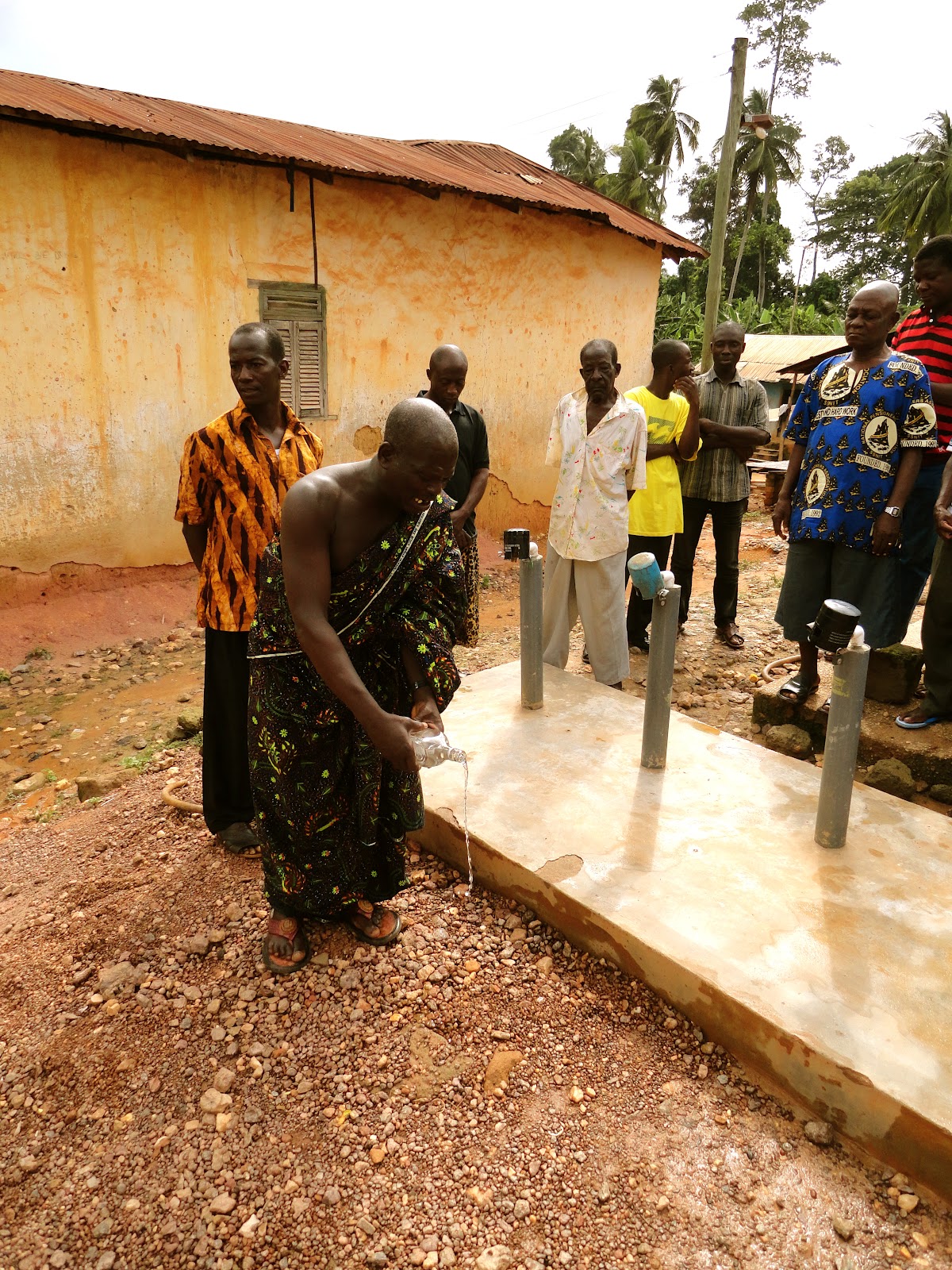
GHEI Country Director Clement Donkor then announced to the elders that the water borehole that GHEI had sponsored the construction of was now complete, and that we wished to formally hand the keys over to the Chief.  Together we walked to the site of the new borehole.

Previously people in Humjibre would use water pumps to collect their water, which is quite a laborious task.   Since most residents of Humjibre don’t have running water all the water for daily living had to be obtained in this way. This new borehole features four faucets fed through an elevated Polytank, making life that much easier for the surrounding community.
 
In the United States the average water used per person is between 250 and 300 litres of water (65 to 78 gallons) per day for drinking, cooking, bathing and watering their yard (Pacific Institute).  Imagine for a moment that you had to pump your entire daily water supply by hand, then transport it back to your home in a bucket carefully balanced on your head.  At those rates it would take more than one trip!

Before handing the keys to Nana Kwadwo Twum II we bowed our heads in prayer, asking for God’s blessing on the use of the taps and all those they will serve, followed by the pouring of more libations on the ground.  The faucets were turned and each of us cupped our hands under the brisk running water, splashing our faces to cool off under the blazing sun.  I took a big sip of water, which I had been craving since my swig of gin.


GHEI Country Director Clement Donkor hands over the keys to the borehole to Nana Kwadwo Twum II

Share |

Saturday, June 9, 2012

We Are The Future


GHEI’s Girls Empowerment Club usually meets twice a week throughout May and June to promote girls’ education, discuss self-expression and build self-esteem amongst other things. Recently the girls have made an extra push, meeting every night to practice new songs and run through plays in preparation for their big welcome performance for the first group of Summer Serve and Learn volunteers.  After hours of rehearsals, the Girls Empowerment Club gave a memorable performance for both their community and the newly arrived volunteers Wednesday evening.

The crowd stirred impatiently with anticipation as they waited for the show to begin.  As the young women trotted out to the beat of blaring dance tunes, the crowd could not contain themselves.  Parents pointed out their daughters with pride, and the audience was immediately won over.

The audience was wowed by a night of singing, dancing and short skits, all delivering a message of gender equality.  For some spectators this was an unfamiliar message that challenges the status quo in rural Ghana.  For others, it is a new reality for the younger generation in which girls are given the same chances as boys both academically and socially.

Satisfied with their performance the girls bustled off the stage. The thundering applause gave way to an all out dance party as the DJ blasted ‘high-life’ music and the crowd erupted into an undulating mass.  Meanwhile backstage the girls celebrated and congratulated one another on a job well done. Their message was sent loud and clear.

Our volunteers were thoroughly impressed by the unforgettable performance and are very eager to work alongside the Girls Empowerment Club in developing leadership skills, building self-esteem, teaching business and money management, and discussing safe sex and family planning.

We at GHEI are extremely proud of the Girls Empowerment Club for their diligence and perseverance.  Way to go girls!


Share |

Tuesday, June 5, 2012

Songs of Hope


One by one, the young women of GHEI’s Girls Empowerment club file into the classroom. Smiling and joking with one another, their enthusiasm is unmistakable. Tonight’s session will have the girls learning and practicing new songs for their upcoming performance for the first group of Summer Serve and Learn Volunteers.


GHEI staff members Aggie Obeng and Enock ‘Happy” Nkrumah lead them through the new material, and at first the girls are bashful, singing just above a whisper. Within moments they have found their rhythm and are singing in unison, as though they had known the songs for years.

These are no ordinary songs. The lyrics depict a bright future for these young women, a future in which education will be their key to a rich and fulfilling life. In a country that often favours boys’ pursuit of schooling, these girls deliver a simple message. They are perfectly capable and incredibly passionate in seeking the same academic opportunities that will enable them to blossom into the next generation of Ghanaian leaders

Educate Your Girl Child


Educate your girl child, in the area of empowerment;
Send her to school, she may be great,
Don’t waste her time, don’t waste her talent, this is the time, send her to school.
Teachers we need, your girl child may be one, Engineers we need, and she may be one.
Lawyers we need, your girl child may be one, Nurses we need she may be one.
Miners we need, your girl child may be one, Pilots we need, and she may be one.
Doctors we need, she may be one, Oh yes, don’t waste her talent, send her to school. Send her to school!


Friday, May 18, 2012

"Filthy water cannot be washed." -West African Proverb


Pure, drinkable water has always bubbled from the hill near the village of Humjibre. This clean water source has sustained generation after generation of villagers through severe dry seasons and periods of drought. The town elders wisely decided to establish a perimeter around the coveted water inside which the discarding of trash, farming, use of pesticides and even the wearing of shoes are forbidden. 
These same practices continue to this day.

 As the community grows, so does the need for more efficient ways of retrieving and transporting water from wells to homes within the community.

During early morning and evening hours, you will see parents and children transporting water in large basins perched on top of their heads from the wells to their homes. All the water that is needed to carry out daily activities (such as cooking, washing, cleaning, showering...etc) is transported in this manner. In addition, most wells have not yet been motorized and require hours of hand pumping to fill these basins.     

GHEI has undertaken a project of raising funds to install motorized pumps and polytanks to supply Humjibre residents with fresh water. This past week GHEI staff and community members helped install a motorized pump to transport the water from a borehole into a polytank which will then be easily accessed by a row of facets that the villagers can use to easily fill their containers with instead of hours of hand pumping.

As the Humjibre community grows so does GHEI's efforts to help support and develop the community.


Photos by Mandy McConaha
Share |

Thursday, May 3, 2012

World Malaria Day 2012

Music boomed from the Humjibre Community Center and warm light spilled out of open windows and doors beckoning people to come and join the festivities. The day is World Malaria Day and in Ghana, Malaria is one of, if not the greatest health risk accounting for nearly a third of all deaths in children under 5. The most dangerous malaria parasite, of the 4 that infect humans, is by far most prevalent in Ghana where it accounts for up to 98% of infections.

These facts combined make this an extremely important day to spread the word in Humjibre as well as in the neighboring communities of Soroano and Kojina about preventative measures that each individual can take to protect themselves and their loved ones. Slowly people began to trickle into the Community Center and the seats began to fill with young mothers carrying babes on their backs, old women with lined faces hunched over from years of hard living, and the excitable, squirming bodies of young boys and girls. The music ebbed and members of GHEI's health team, Aggie and Mensah, stood before their community as role models and leaders explaining the causes and effects of Malaria. Nurses from the local clinics were invited to give animated talks about detecting early symptoms and the audience was encouraged to participate in a bednet demonstration as well as a question and answer session. The evening drew to a close with the showing of a short film, featuring a number of GHEI's health staff, that illustrated the symptoms and appropriate treatment of Malaria, and the importance of a proactive approach.

Malaria prevention is a main focus of GHEI’s Health Program and they have tackled this pervasive problem since 2006 by distributing insecticide treated bednet throughout Humjibre and neighboring communities. The beauty of working at the grassroots level is the ability to adapt and hone a program to the unique needs and demands of each community. Knowledge is power and the GHEI health team found that just providing bednets was not enough. Intervention was needed to educate each household on bednet usage with culturally appropriate material and Community Health Workers were trained to be involved in every aspect from planning, distribution, promotion and community support. The combination of these outreach programs and the empowerment of community members were a necessary step to successfully integrate bednet usage into the daily Ghanaian life.


Share |

Monday, April 23, 2012

Planting a Seed

For the past 3 years, the GHEI Health team has motivated the youth in Humjibre to become involved in their hand washing program as Hand Washing Monitors. The Hand Washing Monitor's job is to encourage their fellow peers to learn the best way to prevent the spread of bacteria and germs by encouraging them to wash their hands with soap at the appropriate times. This may seem like a simple feat, however in a village with as limited resources as Humjibre, finding clean water and soap can be quite a challenge.

GHEI has provided 5 local schools with Polytanks that hold fresh water for this very purpose and conducted educational outreaches to help prevent the spread of illnesses caused by lack of cleanliness. Over the years, the program has increased to 13 Hand Washings Monitors who are selected by the head teachers of each school. These children make sure the schools provide both hand washing basins with fresh water as well as soap each day and act as role models to their peer groups, demonstrating the correct way to wash their hands at the correct times.

 To evaluate the success of this peer based program, the GHEI Health team conducted interviews with 129 students selected from each school to see if they could name the correct times to wash their hands. 96% of these students knew that after going to the bathroom was a crucial time, 75% of the students were able to list before eating as also an important time, and 25% said before cooking.

We here at GHEI believe that the best way to promote true change in a community is to plant a seed and cultivate it into fruition. We invest in the smallest individual to empower an entire community.

Above is the smiling face of a recent graduate from our Hand Washing Monitor Program, Godfred Gyening. With the help of the other Hand Washing Monitors, we bid him a happy farewell and all the best in the future. Enjoy!
Share |