Friday, November 25, 2011

Voices: Mensah Gyapong


“I was a coca farmer at Soroano the first time I heard about GHEI.  Some Obruni’s [foreigners, originally meaning is ‘the ones from over the horizon’] came and surveyed the community about malaria in Soroano in 2007.  We were a little scared with these Obruni’s in our village, but that’s when we heard, ‘There is a NGO in Humjibre and that is why we are here.’
You see, in Soroano, because of the river, we have so many malaria cases.  If it rains, and if the river comes forward, you will even have small water in the community.  Mosquitos like the dirty extended water, and they will reproduce, and bring Malaria.  
So, later, I was at Soroano, just farming, and the Community Health Worker leader CK asked if I would help them with hanging nets and do the malaria program with them.  CK involved me and we worked together for some time.  Then Clement came to the village with some volunteers and informed everyone that these people, the volunteers, are here to help you with your bednets.  They brought 500 bednets, this was enough for the whole community.  ...read more.

Monday, November 21, 2011

New and Old Learning with Dr. Amin Davari and Dr. Nikki Webb

Dr Davari, in class at Bekwai Clinic
Dr. Amin Davari ended up in Ghana because of pizza.  The UCLA pediatric resident heard about a talk on International Health that was happening and thought it sounded interesting. He heard that they had pizza too.  By chance, he happened to sit next to Rebecca Dudovitz, long time associate of GHEI and coordinator of the many trips that UCLA residents have taken out to Humjibre.  While he enjoyed his delicious slice of pie, he heard from medical school students giving a recap of their time in Ghana, and Rebecca mentioned a chance to go to Ghana to support health service out there with GHEI.  

Several months later Dr. Davari was travelling down a shell-shocked road in Ghana, from Kumasi, in a rattling orange bus that wheezed dust as it motored to Bekwai, where he would continue on to Humjibre in a stuffy taxi probably blaring some great mid-90's adult contemporary music. Where he was going, there was no pizza… Meanwhile in Humjibre, Dr. Nicole Webb was already set up for the past two weeks.  Nikki had already begun many of their trainings as well making initial contacts with traditional birth attendants.  

There are three hospitals in Bibiani-Anwhiaso-District; there is only one that is public and affordable with (supposedly) one ambulance for an area that has a population well over a 100,000 and spans 837 square kilometers.  For a pregnant woman, making it to the hospital is not always likely, as it’s roughly a forty five minute taxi ride from Humjibre, when there’s even a taxi available.  There are midwives and nurses at clinics in some larger villages, but sometimes it is even difficult to get to those.  Most women are working up until the day that they give birth; many births happen at a cocoa farm.

In villages in Ghana just like Humjibre, there are women who deliver babies at home. Traditional Birth Attendants are these women, and they belong to a tradition that goes back generations and is a deeply rooted part of Ghanaian culture. Though the exact number is unknown, it is estimated that perhaps greater than fifty percent of babies born each year in Ghana are delivered outside of the health care system, many by Traditional Birth Attendants.  While the knowledge of these women's work is well known in the community, there isn’t a lot of interaction between the medical health services and them.  Amin and Nikki were here to meet these remarkable women though.  They heard the women’s experiences, got to know their technique, and formally established a relationship.

Dr. Webb training midwives
Amin and Nikki were also continuing the neo natal resuscitation training that residents like Beatrice Teatteh had provided in many clinics in the B-A-B district.   In the first few seconds after a birth, many babies cannot breathe, and response to this should quick and skilled.  The residents were here to show the midwives and nurses how.  Amin and Nikki with proper gear, including a dummy baby with lungs that fill with air and a chest that rises, spent several weeks bombing around the district in a string of sketchy taxis. They would arrive at clinics in clouds of dust, with smiles and an inflatable baby, ready to train.  

Some of their students were also coworkers, as Amin and Nikki also volunteered their time at the Bekwai Clinic.  Nikki and Amin, would see patients for a morning, and then bundle into a taxi in the afternoon and head off to a clinic in a far flung area of the district.  Or shoot off in the morning, and arrive slightly bedraggled (but still pretty psyched) for an afternoon in the clinic.  

I followed along and witnessed one of neo-natal resuscitation trainings at the Bekwai clinic.  I was a bit late, so I slunk into the back of the room and watched, as overhead fans mercifully roared away. 

“Is this a good heart rate for a baby?” Amin, with an assistant at his side and an imaginary stethoscope in his ears and on the plastic baby in front of him, tapped his finger on the table in a slow rhythm.  The answer was a resounding No from the audience.  “No, you are right.  This is much too slow.  What is the number one reason for a baby to have a heart rate that is not good?” Amin asked, in the particular cadence of Americans who are speaking slow enough to be understood by anyone not American.  A pause, and then an answer, “Yes, that’s right, because the baby is not breathing right.”

After training was done, Amin and I trekked up the dirt road back to Bekwai, when a car pulled off and invited us in.  It Mr. Anim, the Bekwai Clinic Senior Health Assistant, and as we got into the car I asked what he thought of the trainings, and he made a funny quip about his staff to the effect that they were allergic to learning, but on the subject of Nikki and Amin he said they were “splendid.” He said the example of their work, and the chance to work alongside them was improving the service of his staff greatly.

  
The hope is that one day, as relations continue to strengthen with the medical health services in the district, that better learning and sharing will take place between the traditional birth attendants and future volunteer residents.  In much of Africa, there can be a dynamic friction between the traditional and the modern, between the new learning and the old ways of doing things, this can be a difficult bridge to build.  The reality though is that the average Ghanaian is already a mix of new and old; they exist healthily within that tension, and the hope is that GHEI services can exist there with them.   GHEI is committed to the total health of the residents of the B-A-B district, no matter where the service comes from, old or new.


Share |

Thursday, November 17, 2011

Volunteer with G.H.E.I. in Humjibre, Ghana this summer!


We are now accepting applications for G.H.E.I. Summer Serve and Learn 2012!

GHEI Serve and Learn volunteer programs give short term volunteers an experience in a different way of doing development work in Africa.  Our work is grounded in the communities we serve, and by volunteering with GHEI in Humjibre you will profoundly experience life in rural Ghana.  Join us working on a better world in one small corner.

Session 1: Girls' Empowerment (June 4 - 20, 2012) / Session 2: Read and Play (June 22 - July 8, 2012) / Session 3: Kickin' It in Ghana (July 10 - 26, 2012) / Session 4:  Malaria Prevention (July 28 - August 13, 2012)


Download the FAQ's  

Download the application and send it to Tabatha at apply@ghei.org
... 

We've blogged about our amazing summer programs quite a bit here.  Check out last summer's programs and people:

Read and Play 2011 volunteers created a literacy outreach to local primary schools and wrote a catchy song about taking proper care of your books. 

Girls' Empowerment 2011 volunteers spent two weeks learning and sharing with girls finishing junior high studies, culminating in a traditional Ghanaian feast that they prepared with the girls help.  

Malaria Prevention 2011 volunteers assisted Community Health Workers to undertake a massive community survey on bednet usage and got to visit folks among the many unique neighborhoods in Humjibre.  

Build Ghana 2011 session (now more appropriately titled "Kickin' It in Ghana") was about teamwork and the volunteers demonstrated this themselves while collaborating on a teambuilding camp, hosting a popular football tournament, and tutoring local staff on computer basics.  

Of course, that's only some of what they did during the day.  Life in Humjibre is so much more full and vibrant than that.  Here is one person's reflection on what volunteering in Humjibre meant to her.  
...
My time here greatly changed my understanding of development work. As a matter of fact, I learned a lot more than I was anticipating. I am convinced that my time spent in Humjibre has helped shaped the beginning of my path in life. 
- Oluwaseun Ososami, Build Ghana 2011

Share |

Monday, November 14, 2011

Letters from Humjibre, Ghana...


Every few months,  we put together a small mailing to those who have supported GHEI for a number of years.  Since it take roughly 600 years to get mail from Humjibre to USA, we're already starting to mail out holiday themed letters.  

We've got some great letters this year from our YEP after school program.  Our YEP program is for high achieving students in Junior High, and in these after school classes we teach advanced High School level lessons on English, Mathematics, Social Studies, ICT, and Science.  Many of these kids speak English well, but you can tell that they've spent years studying English very hard...from a book.  Their flowery prose and gentleness is a wonder to behold, mostly because it's so rare to hear in the way we native speakers converse in our subtle, ironic ways. 

These letters are solid gold, and I couldn't help but share some great quotes.  Even though some are very funny, and it's a bit early for Christmas, I love how their heart-on-their-sleeve honesty comes popping off the page.  Enjoy.

“I greet you all in America, and say Happy Christmas to all of you.”  -Akosua

“My name is Stephen.  I am very jovial and every morning I give birth to success. When you read my [letter] you will be caught up in the sky with joy..I hope you are swimming in the coming joy of Christmas...” –Stephen


“I am very happy about Christmas because my parents will kill a full chicken for me to eat!” -Gladys

“My favourite football player is Lionel Messi on F.C. Barcelona. So I like Christmas because I get time to watch my favourite [football] matches and watch war films.” –Justice
 
“My wish is that in the New Year, I want to abstain my self from bad things. This is difficult.” - Lawrence

“My name is Ebenezer but [the] population calls me King Pogasty or Rastico...I was a good man [this] year and I don’t like those who frown on their face and I don’t like those who play with fire.  It means to tempt serious trouble!” – Ebenezer. 

“There is also a festival here called the Yam Festival.  There is dancing and singing.  Here is a special town if you come here, you will not go to your own town.  You will want to stay here until you die!” – Lawrencia 

"I am happy for Christmas because I have got new clothes and some sandals, which I will use...One more thing, if God [does] not permit Christmas holiday and me to meet, I will be sad and worry.” -Dorothy. 

“If you come on Christmas day I will take you to my church and sing a nice song to you, so please, come and let us celebrate the Christmas together...I hope the next year will be the best year to you and me." - Susanna


Share |

Friday, November 4, 2011

Lending a Hand, Here and There, in Humjibre


Last week, the staff at GHEI engaged in the provocative act of painting a message on the side of a building.  It was not street art, it was actually a task that had been on our to-do list for some time, which was to paint GHEI’s mission on the side of the classroom, directly by a popular footpath. This would be an effective way to advertise what we are here to do, because, as I found out a little while ago, many know that we are here to do good things but few know what those good things are.
 
Painstakingly, Jen stenciled in the letters by pencil in the morning, expecting that we would tackle it at some later date. Before long, Happy and Clement had already gotten out the paint, and everyone was picking up a brush.  Some of the recent additions to our team even joined in, like our National Service Volunteer Emmanual Hagyrahirah  and Nikki Webb, a Pediatric Resident from the states here for three weeks to provide training to clinics in the district.  Some had detailed skills, others needed a little practice, but fortunately there were a lot of letters, and thanks to everyone pitching in, we finished mid-afternoon.


While we’ve been at the forefront of a big push in local schools to get student’s hands washed, the need to keep our own students hands clean, somehow got lost in the mix.  Which is why the Health Team recently unveiled the new Veronica bucket (a bucket with a small tap at the bottom for running water), especially for our Early Childhood Literacy students and young library patrons.   Education staff keeps an eye out making sure student’s hands are getting clean, while Health Team puts the bucket out for use. Much like the gentle camaraderie of our painting mission, Health and Education are working together to keep the water flowing. 


Just recently, we had our annual ECL vs Library football match.  The students who regularly patron the library after school are selected by Lawrence to form a team that squares off against the ECL students.  It’s a popular match, and even those kids not normally going to the library come out to support their friends.
 
The pitch itself leaves much to be desired unfortunately.  The spaces infront of the library is rutted and eroded from the heavy rains that have tapered off recently, but come roaring back every few days.  It’s quite a challenge, and I can’t imagine playing on that field (somewhat like how I have difficulty envisioning playing on the rock strewn official field), but to the kids it’s no sweat, the ball just bounces a lot.  Girls Library won their match with a touch of finesse, while the boys team played to a boisterous and sweaty draw of 1-1.


The day was a scorcher too, and kids were getting thirsty real fast.  Noticing this, young Attah asked Jen for a bucket of water.  Together they got a bucket of water, and Attah spontaneously organized a rehydration unit.  She organized lines, and with just one cup, she quenched dozens of kid’s thirst.  I stood impressed watching this, and even more impressed when she sent a kid to the back of the line for trying to cut, and then withheld the cup when there was too much pushing and shoving. 

It was neat to see her lending a hand...


Share |

Thursday, October 27, 2011

Ode to the Aduanaba Information Centre


If you have spent any time visiting Humjibre, chances are you’ve been woken up at 5 A.M.

Indeed, this town, known as the place of rest, comes wildly alive very early thanks to the two information centres in town.  Over loudspeakers, announcements are broadcast at peak volume; loud enough for everyone in Humjibre to hear them, loud enough to wake you up.
 
When I first arrived, I loved the concept. It’s a giant audible internet message board! It’s Humjibre’s morning news program!  It’s like someone took the 'Local' section of the newspaper and yelled it at you! Neat!  My enthusiasm did not last long…

Somehow, I’ve adapted my sleep patterns to it and the loud voices in Sefwi don’t always wake me up.  Now,  I only really wake up if I recognize the voice.  GHEI often makes announcements about its outreaches or if they have a special PSA like the one Aggie made last month, but why, Saga, why?  Why do you have to tell everyone about the Early Childhood Literacy classes so early!
 
After several months of lingering curiosity, I set off to the origin of the early morning noises.  I’d spent a summer hearing questions from volunteers that I felt needed to be answered: “Why are they so early?” “What are they announcing?” “Singing? Really!?!”

With Lawrence in tow, as my translator/cultural attaché, we set off for the Aduanaba Information Centre near the centre of town to answer those questions and learn more about the early morning cacophony.  We found it empty but I had my first look inside, and with all the equipment set up just so, it was like a compact, pirate radio station.  There was room for only one.

 We asked around where the proprietor was.  Lawrence gave him a call, while I snapped some photos.  He was at home, and off we went.  We met Isaac Baidoo as he was spreading cocoa out to dry after a day of farming.  We sat on a bench in front of his house, and I presented our mission in English. He looked confused, so I nodded to Lawrence who presented our mission in Sefwi.  He was still confused, but now also amused.  

For 1 ($.75) Cedi, Isaac makes announcements for others, or allows others to make announcements, at two times, once in the morning and once in the evening.  Each follows a similar sort of pattern, but the mornings are laid out this way: Between 4:30 and 5 AM is the time for various religious announcements, whether they be church gatherings, preaching, or a new sect that might be setting up.  The price for this time is negotiable and often Isaac lets them on for free for no more than 20 minutes, expecting that if they are blessed by donations, he will also be blessed with a small gift from them.  This is often when the singing happens: Pre-Sunrise Hymns in Humjibre.
 
The second segment is for personal announcements, and these announcements happen between  5 – 5:30 AM.  These announcements can be a place to make announcements about important events in families such as funerals, or births, and it is when the chief would be broadcasting decrees.  It is also a place to air out grievances, such as announcing theft from your farm, whether the culprit is known or not. One can also broadcasts insults and comebacks to insults slung out earlier, which seems to me could lead to a vicious war of words over the airwaves. I suppose the 1 cedi price tag restricts the frequencies of this, I mean, surely at some point it’s going to cost too much to continue insulting each other… I posed this to Isaac.

He assured me that he has a small interview with everyone before they make an announcement to judge the content of their message, and, I’m guessing, the content of their character. I don’t think the chief would let excessive hate flinging happen in Humjibre, either.  In fact, the chief was the one who decreed the time limits on the announcements to begin with.

The last session lasts between 5:30 and 6 AM, but often longer.  This is where people can try their hand selling some products, like all natural healing balms or various other wonder cures, like efficient door to door selling.  Different chop (*food) stalls along the Humjibre strip will take this time to announce special additions to their menus or moments when soup is on. Breakfast is one of the busiest moments for the chop industry in Humjibre, so these last minute announcements for ampesi  or hot stew dishes with yams are probably a good bang for their cedi. 
   
Isaac has been in the announcement business for five years now.  The Aduanaba Information Centre is one of two announcement systems in Humjibre, I asked about competition between the two.  “Daabi, daabi,” he said, quickly shaking his head.  They were the first to make announcements in Humjibre, they were pioneers in the field, and he affords them all respect.  Yes, I said, but what if you both make an announcement at the same time?  Who wins then? The loudest volume?  Isaac laughed at my barbaric view of media, and said that he defers to them.  They give him a signal when it’s his turn, and he starts his announcing.

I was impressed by how complex this system was.  From my bed, stewing in groggy frustration, it sounds like the blown-out chaos of overly excited voices, and now I see there’s not just a regulatory system in place but consideration and respect.
 
I asked Isaac if I could make an announcement, he said of course.  I asked if I could give him some nice, soft music to play in the morning, music that wouldn’t wake us up but give us a relaxing sleep for another 20 minutes.  I imagined Chopin lilting out of the speakers. 
 
He said sure, it’s your money.  I asked if people would like this, because there are a number of people at GHEI, now and previously, that would probably love it.  He said maybe, but not many people complain about the morning announcements in Humjibre.  Most people, he said, complain during the evening announcements, when their nightly news comes through their radios, when they’re trying to sit and have a meal and a conversation with the family, when the youth are hanging out on the streets.
Isaac and Lawrence
Lawrence elaborated, “Everyone’s already awake at 5 AM. The only one still sleeping is you.”

Share |

Thursday, October 20, 2011

GHEI Handwashing Education Reaches Hundreds, And Then, Hundreds More...


For those who moan and complain about the state of the world, the developing world in particular, GHEI's Handwashing With Soap Program has seemed to me the antidote to that sort of cynical bellyaching. 

“It’s hopeless man; the world's hurtling towards 2012, the poor keep getting poorer and sicker, the rich are richer, and I can't afford the latest iPhone.  Nothing changes for the better, life sucks,” a person might say in the bored sneer of western apathy.

This person is wrong on many accounts: You can buy used iPhones on the streets of Kumasi for pretty cheap. (Of course, without showing off the latest iPhone how will people know you're better than them?) The rich are indeed richer, but average people are getting wise to that. Ghana has the fastest growing economy in the world right now. Malaria deaths are down by 20%  worldwide in the last decade.  2012 is a myth and a terrible movie.  For heaven's sake dude, it's not hopeless

Take GHEI's Handwashing With Soap Program: It's a very simple concept (teach young people when and how to wash their hands properly) and it can lead to powerful results.  Proper handwashing is a proven method in reducing instances of the biggest killer of children under five in Africa: diarrhoeal illnesses. 

Over the course of this past week, in celebration of Global Handwashing Day on October 15, the Health Team attended 7 Primary and Junior High Schools in Humjibre and Muoho to demonstrate the importance of proper hand washing.  Thanks to many donors who have generously come out in support of Humjibre's youth, GHEI has installed Polytanks (large tanks that fill with rainwater, and have taps on the bottom) at all schools in Humjibre and at one in Muoho.  

Several months ago, in my second week in Humjibre, I tagged along with the Health Team to visit Muoho Primary School and watch a handwashing outreach.  These latest outreaches followed a similar dynamic, but the swelling mass of young humanity and the soapiness were increased sevenfold.  On October 11,12, 13, Mensah, Aggie, Carly, and Saga reached over 1500 students in the Humjibre area with an educational review of handwashing.

These kids knew the handwashing song pretty well, and the way they answered the question regarding the critical handwashing times showed something all too rare in the education system in Ghana: Critical Thinking.

 “What are important times to wash your hands?” asked Aggie to the hundreds.  Several hands shot up.  Aggie chose a boy who seemed anxious to answer.

“After handling poison!” he said.  Aggie was briefly thrown off and then said, yes, please wash your hands after handling poison. The standard appropriate answers trickled in later: after toilet, before cooking, before eating.

At the D.C. Primary, I hung out among the class 5 and 6 kids.  While the younger kids were taking turns at the polytank, these older ones stood in a line in the shade. Although, they were all supposed to be silent, these kids were whispering and making fun of each other.  As I was once like them, I assimilated myself.

Do you wash your hands at home?

“Yes, of course, Mr. Obruni.  Do you wash your hands at home?”

I said yes, at all critical times.  I even wash my hands before I attempt to cook food.  They all laughed. How did they know I was a terrible cook? Incensed, I asked why, but they were laughing at the idea of a man, pounding fufu, cooking soup, serving food.  

The way life changes so fast here in Ghana, I don't think these young guys will be laughing in a few years...Having the fastest growing economy in the world means a whole lot of other changes come with it...

“At home, I tell my brothers and sisters to wash their hands.  But, me, I wash all the time,” said a boastful young man who had just lifted up his school uniform to proudly show his Manchester United jersey underneath.  Then he made a joke in Sefwi that cracked the whole group up.  I smiled and took my cue, strolling over to the polytank to watch the giggling little one press up against each other, jockeying for a chance at the tap.

I thought about the changes that Ghana is going through, and I wondered what it was like for that young man in Manchester colours at home.  I imagined how he might show his younger brothers and sisters at home what he was learning that day, and how his parents might look at him strangely and might even learn something new themselves...

As effective of an outreach that I saw from us at GHEI, I can't think of a more effective outreach than this boy showing his younger siblings how to wash their hands properly.


According to Aggie, this isn’t a lone phenomenon.  A mom in Humjibre told Aggie that her kids won’t allow her to start preparing food until they’ve seen her wash her hands.  Students teaching brothers and sisters teaching parents...GHEI reached over 1,500 students in three days, but how many siblings, parents, and friends have also been reached because of these outreaches?

So no, it's not hopeless.   

 
Share |

Friday, October 14, 2011

GHEI Staff Celebrate Outstanding Service From 2011 Volunteers

Here are this year’s Outstanding Service Award winners, in GHEI staff’s own words. 

Ernest ‘Saga’ Badu on Meera Patel:

Meera was dependable, when she said we would learn something, we would learn it. During computer training, I learned how to draw a pie chart on the computer.  I will be using that in the future during my exam questions.  I can do it now without her supervision, but only because she helped me. 

Aggie, Meera, Tola, and Poranee

She was cooperative at the football camp, she made sure everyone had a chance to participate.  She was always fair to everyone involved, and she was always thinking about what she could do to help others.  She responded to problems, in the football tournament, she was like a medic.  When someone would get hurt, she would go to them, and she would attend to them seriously. 

And she is very friendly, but she was also very good at pretending to be a bad sportsman during the camp.  And I thought that was awesome.

 
Dickson Akah Mensah on Sarah Gustafson:

She was dedicated, very hardworking, and she had very good interactions with all the people she saw.  The way she talked to people, she made people feel very comfortable.   The mothers who brought their children were very happy when they saw her, and the children also liked her.  Even if some cried, she was very gentle and they liked her somehow after crying.


She represented GHEI very well culturally in Ampenkrom.  And wherever she went she created a very good environment.  There were many people who liked her

Sarah and Dickson
 I think she needs to come back!  This is volunteer work, and its rare to find someone with so many good quality of leadership.  We were very lucky to have someone who would do this voluntary, and be so skilled.  She must come back to Ampenkrom next year!

Aggie Obeng on Erin Rosen:

She was very nice and friendly but also liked we had done when we finished for the day.  At the end of the day she was always praising what we had done and praising the way all of us were doing the work together.

 
When there was something that needed to be done on the surveys she consulted people individually, and she was very serious.  If the interviewer did not understand how to ask the question properly she made sure that they understood, but it was always in a nice and friendly way.  She never made people scared, but she was serious about the work.


I really like what she accomplished when she was here.  Not only the work she did, but the way she did her work was also very good. 


Lawrence Donkor on Krista Nickerson:

In session one of Summer Serve and Learn 2011, there were three volunteers and they all did their best, but Krista distinguished herself in that she really understood the words “Serve and Learn”.

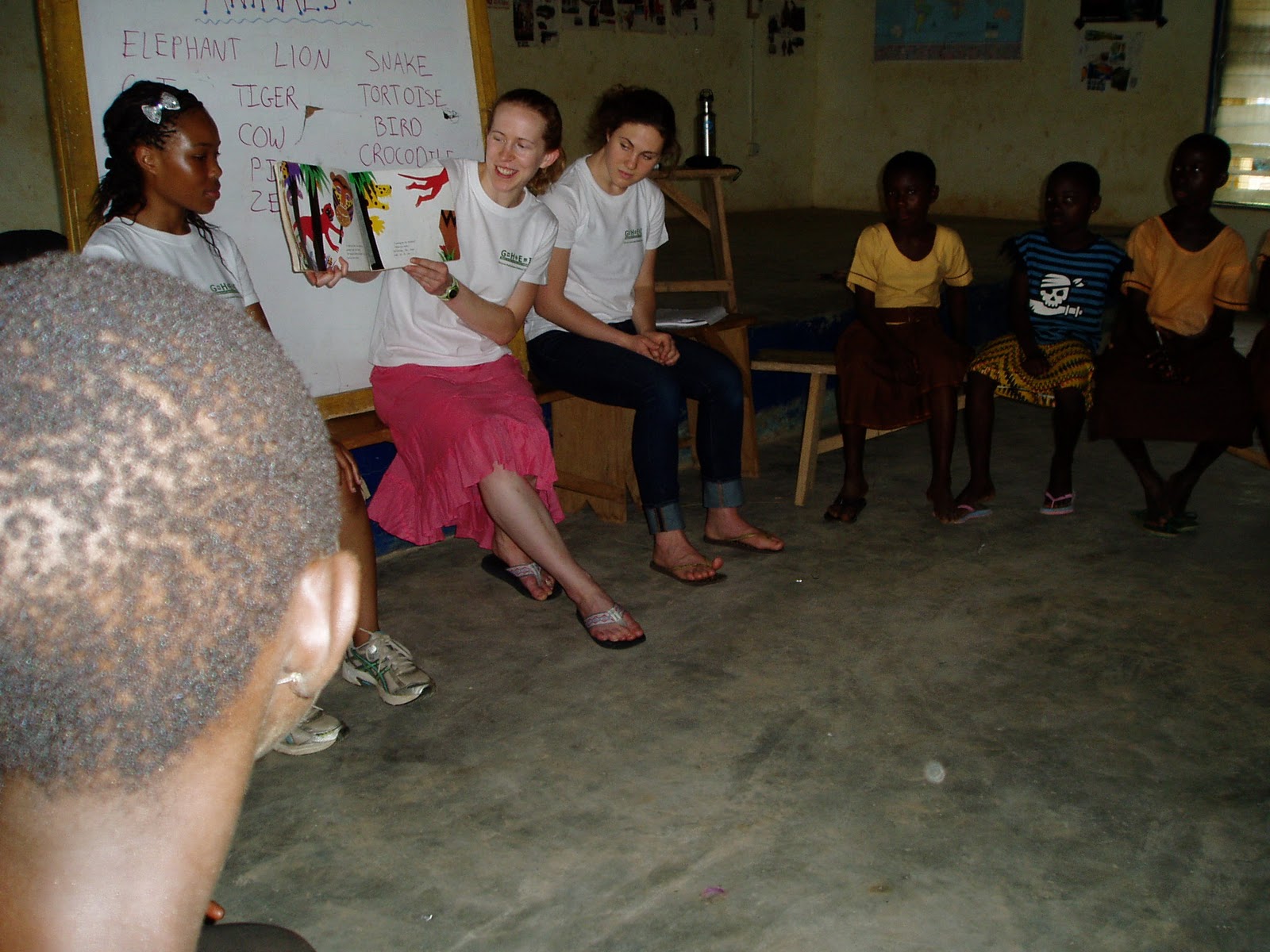
Krista reads a book while Helen and Lexi look on

She was active in working, sharing concerns, asking questions to know what she needed to know and was positive in all the activities.  To me, the most interesting part is that she likes working with different people and showing a lot of qualities that shows that she can be a leader.    She showed respect to all people from students, GHEI staff members, and volunteers and their community members as a whole.  She acted exactly the same in session two.  Again she is the first person to take lead in all the activities and the role plays, because of that some of the girls from Girls’ Empowerment have taken her as their role model.  


More or less, she spent only four weeks in Humjibre but still, people had her name in their minds, which I think is good.  

On our Facebook page: Check out Erin's photo album of her time in Ghana here  


Share |

Thursday, October 13, 2011

GHEI Now Hiring! Are You An Awesome Person? APPLY!


In some sort of bizarre proto-national twist, the neighborhood that hosts GHEI, and the many volunteers and long-term coordinators from around the world that are serving Humjibre, is called Canada.  It's not called this because the townsfolk of Humjibre have designated this area of town as some sort quaint cultural milieu, like their own Chinatown, but in reality this area was called Canada long ago, when people began to build their homes on the slight hill where I now live.  The air was cooler here than in the rest of town, so they decided to name it Canada, because you know, it’s cold there.  Thus, some are from that Canada and live in this Canada.  

 Jen is the Education Program Coordinator here at GHEI.  There are a lot of education programs, and this keeps Jen busy but she also teaches Early Childhood Literacy (ECL), and in Jen's words ECL is there “to catch the ones who are about to be left behind in school.”  They gather first for some purposeful play with each other and Jen while the late comers straggle in.   They sit at the table constructing epic structures with building blocks and various other little preoccupations, but in essence, these six and seven year old kids spend twenty minutes hanging out, speaking as much English as they got. 

To Jen, this time is just as important, as the actual lesson, and maybe among the most important part of her busy day. We learn so much in the smallest moments we spend with each other. Sometimes, the small moments teach us more than our actual classes.  

GHEI is now hiring for an Education Program Coordinator and a Communications Director, Jen and I respectively.  Living and working with GHEI is no piece of cake, but I can't think of anything meaningful that is.  And, though I've said it many times here, the people here are wonderful.

If you’re looking for more than a year’s worth of small important moments, apply.  Come live in Canada in Ghana, it’s a great neighborhood.

You can check out the job descriptions and download the applications on our website here.  

Share |

Wednesday, October 5, 2011

Aggie Has Something To Say About Malaria

Community Health Workers
 From an article in Modern Ghana:  “According to the National Malaria Control Programme, ‘During 2009, a person in Ghana died from malaria about every 3 hours. This means about 3,000 people died of malaria in Ghana that year alone, most of them children.’"


I remember Lawrence showing up to work one day, sweating heavily, with a dazed look in his eyes.  I asked what’s wrong, and he waved it off, “Oh, it’s nothing, just a little malaria…” as though it were a case of the sniffles in Canada (which would lay up your average worker with whines and daytime TV).  “I’ve got some medicine, I just need to enter the attendance from the library last night…”

In 2004, at the Bibiani Hospital (the only public hospital in the district, and the one that people in Humjibre must attend; it is about 33 miles away, and it has one ambulance) malaria accounted for 43.7% of admission (according to Ghana Health Service).  Malaria was responsible for 34.5 % of all deaths; 38.7% of all deaths of children under 5.

Despite its potential fatality, Malaria is a way of life here, its frequency and severity is seen as a burden to bear…

GHEI has taken a very aggressive stance against Malaria in Humjibre, and in the neighboring communities of Sorano and Kojina.  We have distributed Insecticide Treated Nets to all sleeping areas in those communities and have enlisted the CHW’s to constantly push the necessity of these bednets through education outreaches and one on one follow up visits.  Still, like any community anywhere, apathy can set in.  

Aggie Obeng, Mensah Gyapong, and Carly Edwards have begun taking decisive measures to combat this apathy.  Here is Aggie’s announcement that has been spread on the Humjibre Public Announcement System, and in many announcements in all 14 churches in Humjibre. The hope is that all 4,000 folks in Humjibre hear this.  It is presented here in its English translation from the original Sefwi:

We have a message for you about malaria and sleeping under bednets.  Last month we had some volunteers come to Humjibre to help us conduct an evaluation survey to see if people here are sleeping under their bednets. Our survey told us that only half of the people in Humjibre sleep under their bednets every night. This concerns us very much. We have given bednets to every home in Humjibre because we want to help protect people in the community from becoming sick with malaria. 


We know that if you are sick with malaria, it is difficult to study well or do good work or take care of your family. Mosquito bites give you malaria, so if you sleep under a bednet every night, then mosquitos cannot bite you when you are sleeping so the time when you can get malaria is reduced.


We have six community members who work with us to help you use your bednets well. We call them Community Health Workers or CHWs because they help teach you about different health issues. They are Yaa Mary, Yaa Nyamekye, Rose Ware, Shadrack Ofori, Mabel Dede Asiedu, Lydia Ampomaning, and Francis Yeboah. Their job is to visit your house once every two months to educate you on how to care for your bednets and to encourage everyone in your family to sleep under their bednet every night. They will help teach you how to hang your bednets and how to mend any holes in your bednets. If you have a question about bednets, you can always ask them.


Please, these people are here to help you with your bednets, but you must also help yourselves. Learn from them so that you will be able to hang your own bednets the next time. We cannot force you to sleep under your bednets. You must understand that sleeping under a bednet every night will help keep you and your family healthy. The CHWs will begin visiting your houses from the end of this week. Please welcome them and learn from them so that we can all work in partnership to keep everyone in Humjibre healthy.

Aggie, and baby Nata on her back, demonstrating on a flip chart the way to tuck in your mosquito net
If you have any questions or need a new bednet, please come to the GHEI office to talk to Aggie or Mensah or inform one of the CHWs. We will ask you to buy a new bednet for GHC2 (about US $1.25). This price is much lower than the price of a bednet at market, where a bednet might cost between GHC 10-20 (about US$7 -15). We have reduced the price of the bednets for you because we want to help everyone in Humjibre to have a bednet to sleep under so that everyone can be healthy.

by Aggie Obeng 
Share |